Commercials and advertisements are all around us. When we watch youtube or television, or even when we open up our computers and surf the web. Heck, even people are walking advertisements! Seeing a friend with a sweatshirt for a college advertises that school, or a person walking in front of you with “Vineyard Vines” on their back advertises that company. Case in point, brands are everywhere, and they have subtle ways of influencing us. But the way they influence you may not be what you expect — commercials do more than just attempt to get you to buy their product.
On December 26, 2018, my friends Casey, Chris, Joey, Trent, and I visited the Chicago Cultural Center. Specifically, we visited the “African American Designers in Chicago: Art, Commerce, and the Politics of Race” exhibit. This exhibit displayed mostly advertising and designs made by African American artisans throughout the 20th century.
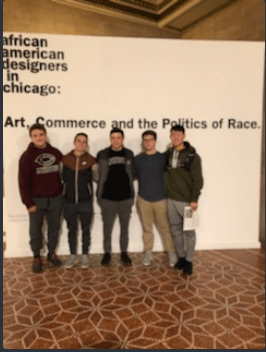
To quote the website, it featured “work from a wide range of practices including cartooning, sign painting, architectural signage, illustration, graphic design, exhibit design and product design, this exhibition is the first to demonstrate how African American designers remade the image of the black consumer and the work of the black artist in this major hub of American advertising/consumer culture.”
But while the exhibit contained wonderful designs and illustrations, in my opinion, the advertisements were the most interesting. In my current English course, titled Contemporary Social Themes, we had discussed the role the media plays on the assumptions and biases we make in our everyday lives. The media tends to oversimplify things and reinforce a certain point of view or stereotype. In order to get the best idea on an issue, one should look at multiple sources and get a holistic perspective on something. Regardless, I never really considered commercials and advertisements as a part of this media. But after coming to this exhibit, I understand that they have a subtle, yet impactful role on the way people view the world.


For example, take this advertisement campaign for McDonald’s (click on the picture to read its caption). At first glance, it depicts African-Americans enjoying McDonald’s food. But it really does more than that, especially with the language used in the captions. The repetition of ending words with “n’” instead of “ing”, and phrases like “gettin’ down”, “dig”, and “ridin’ n’ rappin’” associate a hip-hop culture with African Americans. This association is still existent today — despite the fact that people of all races are fans of hip-hop artists like Kendrick Lamar and J. Cole, people still call this “black music.” Perhaps this is because the artists themselves are African-American, but the association that comes from these advertisements certainly strengthens this point of view.


Another example comes from these Marlboro smoking ads. The box in the lower right hand corner states that the Surgeon General deems smoking bad for your health. Yet, despite this, African American men are depicted smoking them away, because, “Who cares? Marlboro is where the flavor is!” Here in Northbrook, a lot of my peers are afraid of African American people. They see them as scary and dangerous. Perhaps part of this fear comes from the recklessness and risky behavior African American men are depicted doing in these advertisements. Furthermore, growing up, I’ve seen smoking as a mostly “black” activity. This is in large part due to the fact that quite simply, when I was growing up, all of the smokers I came across in my neighborhood happened to be African American. Of course, people of all races smoke cigarettes, this stereotype is false. But these advertisements have a subtle way of reinforcing the stereotype created during my youth.
This type of relation to my own life is what made the exhibit so rewarding for me. The connection that something so simple as advertising has to the assumptions and biases myself and my peers hold is astounding.
I’m not much a TV watcher, so I don’t really see commercials. But after looking at this exhibit, I was curious. I came home and flipped on my TV. I wanted to see what the contemporary commercial scene looked like. To my surprise, I saw tons of connections. For example, Insurance commercials, however humorous, contained mostly white people. In real life, insurance is something that mostly high to middle class citizens have the privilege of owning, so a connection between race and economic class is evident. Car commercials often had white drivers, reestablishing the face that white people often are the ones with the privilege to own such nice things. Other things like sports commercials and beer were often associated with African-American people.
For the most part, I saw a lot of things I would deem “good and healthy” to be associated with white people, and things that I would deem the opposite with black people. Perhaps this is because of my inner assumptions and biases. Perhaps it is the subtle effect of the media and advertising as I grew up that led me to hold these in the first place. But luckily, visiting this exhibit allowed me to examine some of these presumptions for myself. As a result, I’m a much more conscious thinker and I’m so glad I went.
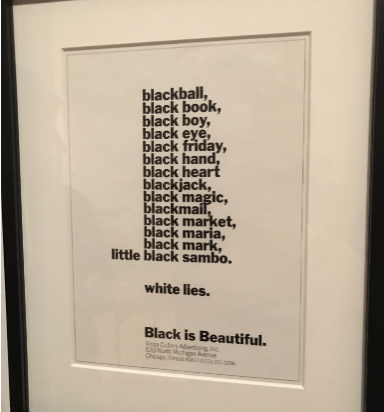
To end, I leave you with some food for thought. What if you were tasked with creating an advertisement for a product? How could you design something that doesn’t reinforce stereotypes? That is diverse and inclusive? Is such an assignment even possible? If so, then why aren’t companies already doing this? If not, then is it possible to come close? And how have commercials and advertisements reinforced the way you view certain groups of people?
 Keypressing with Kyle