As I walked into Smith Hall at Northwestern University on a Sunday afternoon on March 3, I could not have been more uncomfortable. I was present for a seminar/panel discussion titled “What is Anti-Semitism?”, and I knew that there would be plenty of Jewish people attending. And as I took my seat, I quickly realized that I was one of the few people in the audience without grey hair! As a young, Christian teen, I could not have felt more disconnected from my fellow attendees, but I took solace in the fact that I was at least there with a few friends: Joey Harris, Casey Mutchnik, and Trent Williams.


The speaker that impressed me the most was a man named David Shyovitz. He started his segment off with a bang — showing the following image:

The juxtaposition of the Star of David, the main symbol of Judaism, and a Swastika, the main symbol for Nazism and the oppression of Jews, caused clamor within the audience. Clearly they were upset — offended, even — that such an image had even been created. How hateful could one be to combine such a significant image with one associated with hatred and oppression towards them?
But then, David gave us some more info. In Hindu culture, the hexagram represents the union of males and females. Furthermore, the Swastika symbolizes infinity. When the two images are combined, they amplify each other. His point? We should be careful in what we declare as offensive. If we immediately label something as antisemitic, we could be missing valuable context that gives evidence to the contrary.
“CONTINUITIES IN FORM CAN MASK VAST DIFFERENCES IN CONTEXT WHICH CAN ONLY BE DISCERNED BASED ON SPECIFIC CONTEXT” — DAVID SHYOVITZ
This quote really perturbed me. Ignorance begins in the first place when people make assumptions and biases about a certain group. However, when deciding what is offensive and what isn’t, we must be careful to not do the same. While a lot of the time, our intuition is correct, a lot of the time, marginalization is blatant. For example, Claudia Rankine quotes Toni Morrison in her essay, “The Condition of Black Life is One of Mourning”, saying, “I want to see a cop shoot a white unarmed teenager in the back… I want to see a white man convicted for raping a black woman. Then when you ask me, ‘It it over?’ I will say yes.” Because these events simply don’t happen, the occurrences of black unarmed teenagers being shot and white rapists being let off the hook is the result of blatant racism. But not every comment, artwork, image, or song lyric is intentionally hateful. Again, context is everything.
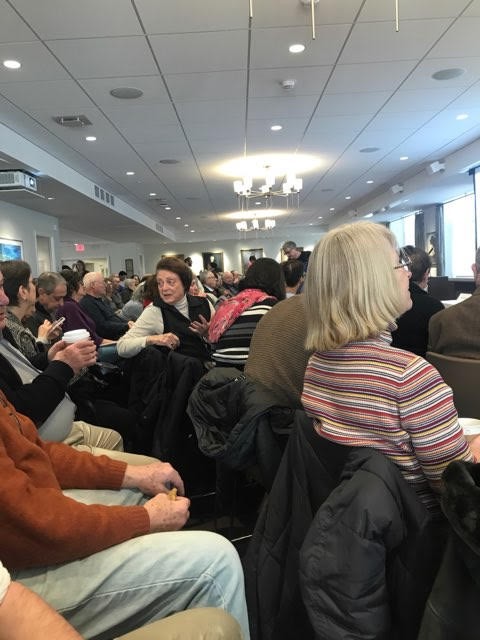
However, after David was finished speaking, I struggled to relate to the other content. The main reason was simply that I didn’t really understand it. While I heard continuous “oohs” and “aahs” from my fellow audience members, I was left confused and unable to identify with much of what was being said. As a Christian, I didn’t know too much about values and ideas within the Jewish faith. Furthermore, I was unfamiliar with many of the events and context that were used to further a definition of antisemitism. Of course, the killing and hatred of any group is disgusting, but why did I feel complacent? Why didn’t I react strongly like my fellow members of the audience? I realized that the answer aligned with some of the course material in my English class. In class, we used Eula Biss’ “The Pain Scale” to examine empathy in regards to pain. Eula writes,
“‘YOU ARE NOT MEANT TO BE RATING WORLD SUFFERING… THIS SCALE APPLIES ONLY TO YOU AND YOUR EXPERIENCE’” — EULA BISS
As a Christian, I am fortunate. Rarely are there attacks against Christians for being Christian — we are a privileged group. As a result, I have never experienced any pain like my fellow audience members have. So, while I may be able to feel empathy for the fact that people are dying, I cannot empathize with their pain — I have never had to react to such events and oppression myself.
Thus is the result of my privilege. I had one uncomfortable experience today due to my brother and I being the lone non-Jews in the audience. I felt silenced in this instance— I did not want to speak out for fear of embarrassment or shame. But also, I realized that I, being a part of the traditional majority, can get away with being relatively uninformed on antisemitism. Clearly, I have abused this throughout my life and have not taken the time to familiarize myself with people of the Jewish Faith. On the other hand, Jews themselves experience oppression and hatred each and every day. They must always feel the same discomfort and inability to be themselves as I did today. I am fortunate that my life comes without all of the hardships of being born a Jew, being born with a target on my back. I also know that in order for such bias to stop, Jewish people need help from those outside their faith. And while I still don’t fully understand this group or the oppression towards them, at least I took a step in the right direction by attending the seminar.
 Keypressing with Kyle